Bhabanipur Shaktipeeth, Bogura
Categories:
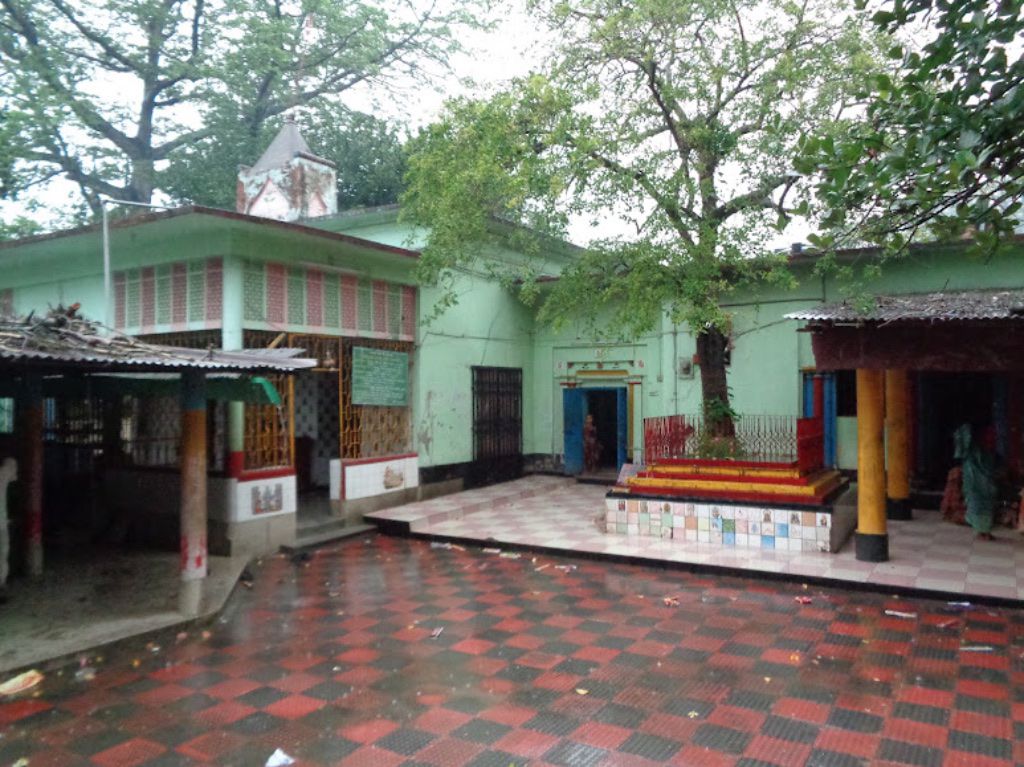
Bhabanipur Shaktipeeth, one of the 51 sacred sites of Devi Tara, stands on the banks of the Karatoa River in Sherpur, Bogura. It is believed that Sati’s left anklet fell at this holy spot. The Goddess is known as Aparna, and the Bhairava here is Bamesh (Baman).
Shaktipeeth
Shaktipeeths are among the holiest pilgrimage destinations in Hinduism.
According to tradition, different parts of Devi Dakshayani Sati’s body
manifested at these sacred locations. Though 51 Shaktipeeths are most commonly
mentioned, the number and locations vary across scriptures. Pithanirnaya
Tantra lists 51.
Shivacharita mentions 51 Shaktipeeths and 26 Upapeethas. Kubjika Tantra
mentions 42, while Jnanaarnava Tantra records 50. These holy sites are spread
across the Indian subcontinent.
In every Shaktipeeth, the Goddess resides with a form of Bhairava.
Mythological Story
According to legend, in Satya Yuga, King Daksha arranged a grand yagna to insult
Lord Shiva. Daksha was furious because his daughter Sati had married Shiva, a
‘yogi,’ against his wishes. He invited almost all gods except Shiva and Sati.
Despite Shiva’s reluctance, Sati attended the ceremony with Shiva’s attendants.
As she was uninvited, Sati was not treated with honor. Daksha even publicly insulted Shiva. Unable to bear her father’s disrespect, Sati immolated herself through yogic power.
Hearing this, the grief-stricken Shiva destroyed Daksha’s yagna and began the fearsome cosmic dance while carrying Sati’s body. Creation moved toward destruction. The gods appealed to Vishnu, who used his Sudarshan Chakra to cut Sati’s body into pieces. These body parts fell in many places across the subcontinent, becoming sacred Shaktipeeths.
History
It is said that long ago, a conch-maker was walking past a pond near the deep forest beside the Bhabanipur temple. A little girl, wearing vermilion on her forehead, approached him and claimed to be the princess of Natore Palace.
She bought a pair of conch bangles and told the conch-maker to collect the price from a basket kept in a particular spot in the palace. Touched by her gentle request, the conch-maker gave her the bangles.
Hearing the story, the queen of Natore went to the mentioned spot with her attendants and the conch-maker. Moved by the prayer of the conch-maker, Mother Bhavani revealed her divine presence by lifting her conch bangles from the sacred pond. Everyone present was astonished, and the glory of Mother Bhavani (Mother Tara) spread across the region.
The Natore royal family later renovated the pond, which is still known as the ‘Shankha-Pukur.’ Pilgrims bathe here during festivals.
Idol
Tantrachudamani states: “On the banks of the Karatoa, in the left ear dwells Baman Bhairava. The Goddess Aparna resides here in her fierce form.”
The presiding deities of this Shaktipeeth are Devi Aparna and Bhairava Bamesh (Baman).
The temple complex covers four acres (12 bighas) of land. It includes the main temple, Belbaran Tala, four Shiva temples, the Patal Bhairava Shiva temple, Gopal temple, Basudev temple, and the Nat-mandir/Atchala. There is also a service courtyard, the sacred Shankha Pond, two bathing ghats, four Shiva temples outside the boundary wall, and a Panchamunda seat.
There are daily rituals such as morning and mid-day offerings, noon worship, evening aarti, and prasadam distribution. Devotees may offer sweets or food and later receive prasadam. Major festivals include Maghi Purnima (Magh–Falgun), Ram Navami (Chaitra–Baisakh), Sharadiya Durga Puja, Dipanwita Kali Puja, and Nabanna (as per the Agrahayan tithi).
Temple Administration
During the era of East Pakistan, misuse of the Enemy Property Act and Debottar (Endowment) laws caused much of Mother Bhavani’s land—originally donated by the Queen of Natore—to be illegally seized. Many properties still need to be recovered.
Journalist Dipankar Chakraborty was murdered on 02/10/2004 during the BNP–Jamaat regime for raising his voice to recover nearly 500 acres of seized Debottar land of Mother Bhavani. Even after nearly 14 years, the real perpetrators have not been punished.
On 13 February 2007, the then Joint Forces demolished a nearly completed pilgrims’ rest house.
Google Maps Location
Source: Wikipedia
Date: 27.01.2022